
"My boss says I can't get it." That is not true.
If you were injured while working in Korea, you can claim industrial accident compensation (산재보험). This is not a favor from your employer. It is a right written into Korean law.
Many foreign workers give up because someone told them they were not eligible. Below is what the law actually says.
Your visa status does not matter
This is the most important part.
The Supreme Court of Korea ruled that a foreign worker without work authorization is still a worker under the Labor Standards Act, and is still entitled to medical care benefits under industrial accident insurance.
Supreme Court Decision 94Nu12067, 15 September 1995
The Court reaffirmed the same principle in a 2015 Grand Bench decision, the highest level of authority in Korean courts. It has been settled law for thirty years.
What matters is not your visa. It is whether you actually worked.
Four things employers say that are wrong
"We don't have industrial accident insurance."
It does not matter. The Korea Workers' Compensation and Welfare Service (근로복지공단) pays you first, then collects from your employer. You are still covered.
"You need my permission to apply."
You do not. You apply directly to the Workers' Compensation Service. Your employer's consent is not required and not requested.
"You have no contract, so you can't prove it."
A written contract is not required. What matters is proof that you actually worked there.
"Let's just settle privately." (공상 처리)
A private settlement usually pays far less than the official system, and once you accept it, recovering the difference becomes very difficult.
What you can receive
| Benefit | What it covers |
|---|---|
| Medical care | Full treatment costs |
| Temporary disability | 70% of your average wage while you cannot work |
| Permanent disability | Lump sum or pension if a lasting impairment remains |
| Survivors' benefit | Paid to family if a worker dies |
Do not miss the disability benefit
This is where most foreign workers lose the most money.
Permanent disability benefit is a separate claim. It is not automatic. Many workers finish treatment, return home, and never claim it.
The amount depends on your disability grade, from 1 to 14. The gap between grades is large. For a worker with an average daily wage of 100,000 KRW, the difference between grade 9 and grade 10 alone is roughly 8.8 million KRW.
The grade is decided by a review committee based on your medical records and examination results. How your documents are prepared changes the outcome.
Staying in Korea during treatment
If your claim is approved and you need continued treatment, you can apply to immigration with your approval documents and medical certificate. After review, a G-1 visa may be issued, allowing you to stay legally while you recover.
Long treatment periods are exactly the situation this visa exists for.
If your claim is denied
You can file a review request (심사청구).
- Deadline: within 90 days of learning of the decision
- Cost: free
- Time to decision: about 60–90 days
A denial is not the end. Many claims succeed on review.
Time limits
Do not wait. Claims expire.
- Most benefits: 3 years
- Temporary disability benefit: the 3-year clock runs separately for each day you could not work
What to do today
Even if you are not ready to file yet, protect your evidence now.
- Photograph the injury and the place it happened. Date and time matter.
- Keep everything from the hospital. Receipts, prescriptions, diagnosis papers.
- Save messages. Anything from your boss or coworkers about the accident. Do not delete chats.
- Write down what happened while you remember it. Date, time, what you were doing, who saw it.
- Keep proof you worked there. Bank transfers, shift photos, commuting records, dormitory mail.
Witness names are especially valuable. Ask now, before people change jobs.
Where to get help
1577-0071 — Foreign Workforce Counselling Centre, run by HRD Korea. 18 languages including Vietnamese, Thai, Khmer and Nepali. Open every day, 09:00 to 18:00. The consultation itself costs nothing; you pay only your normal call charge.
1350 — Ministry of Employment and Labor counselling line. English and Chinese only. Weekdays, 09:00 to 18:00.
Korea Workers' Compensation and Welfare Service (근로복지공단) — where claims are filed.
Be aware that Korea's free state-appointed labor attorney program currently covers Labor Relations Commission cases and wage substitute payments. It does not cover industrial accident claims. For accident cases you will usually need to file yourself or hire a licensed labor attorney (공인노무사).
Kori Care — free guides in English, ไทย and Tiếng Việt. Message us if you are not sure where to start.
This guide explains Korean law in general terms. It is not legal advice for your specific case. Nothing on this page is a guarantee of any outcome.
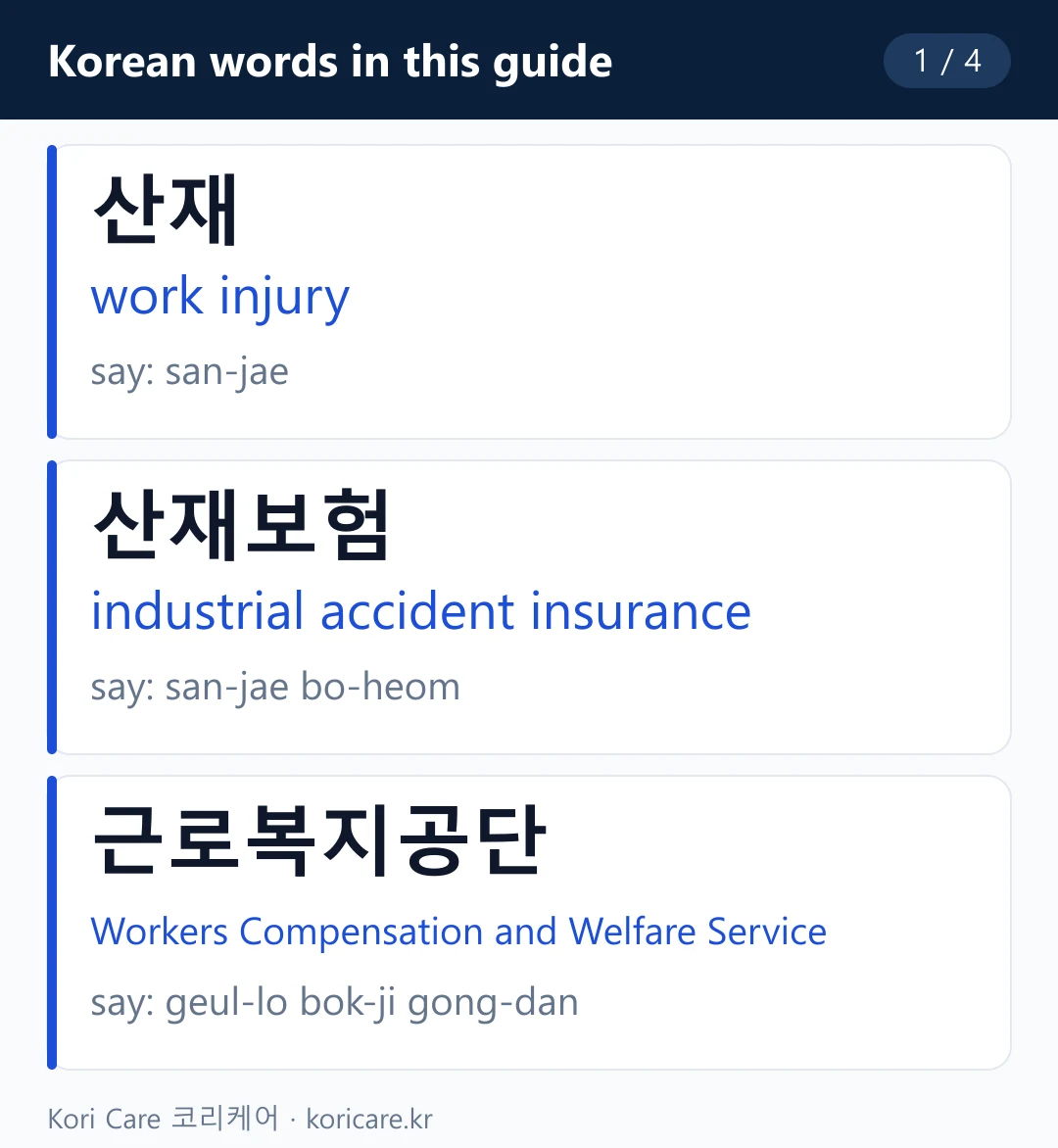
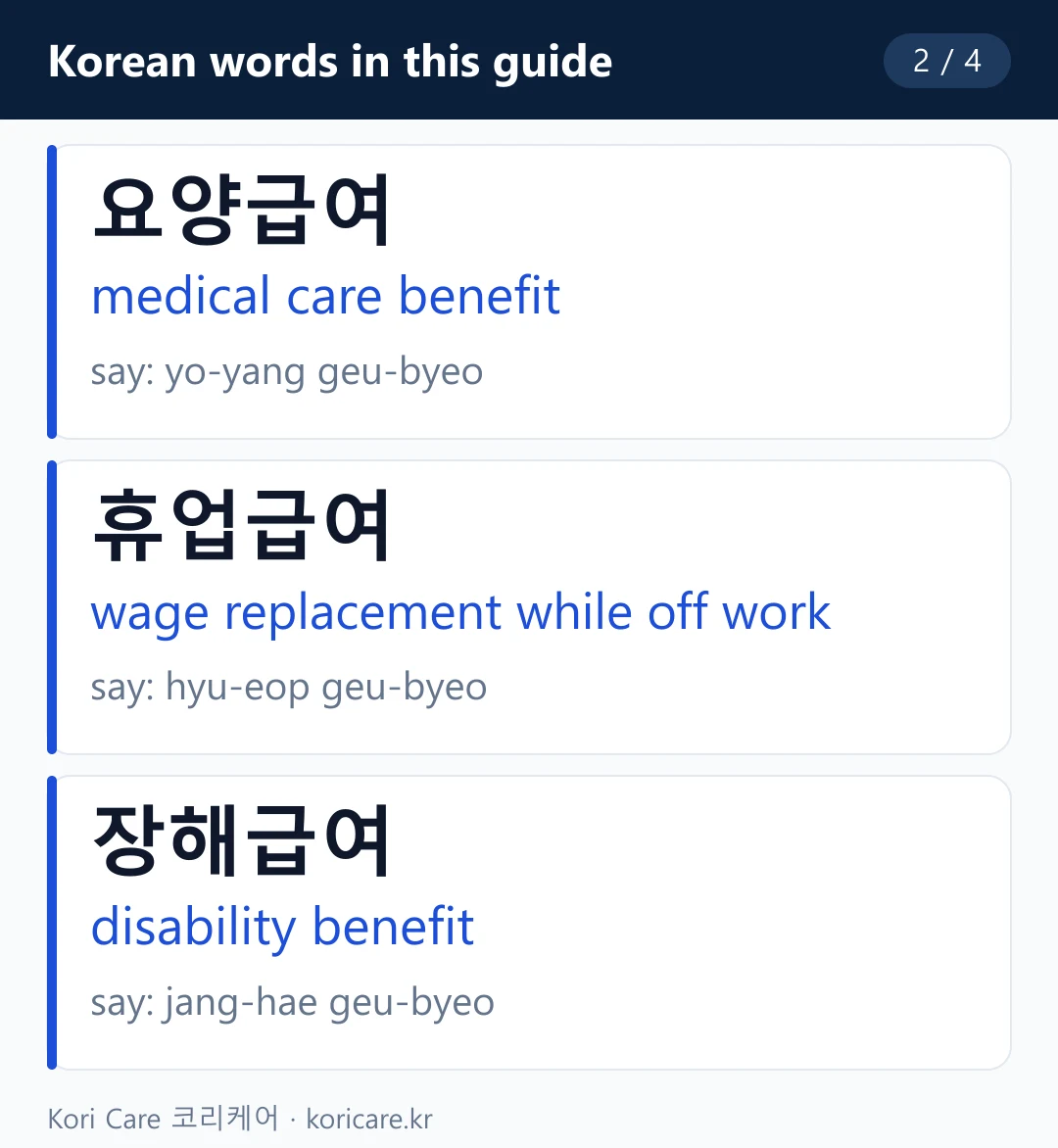
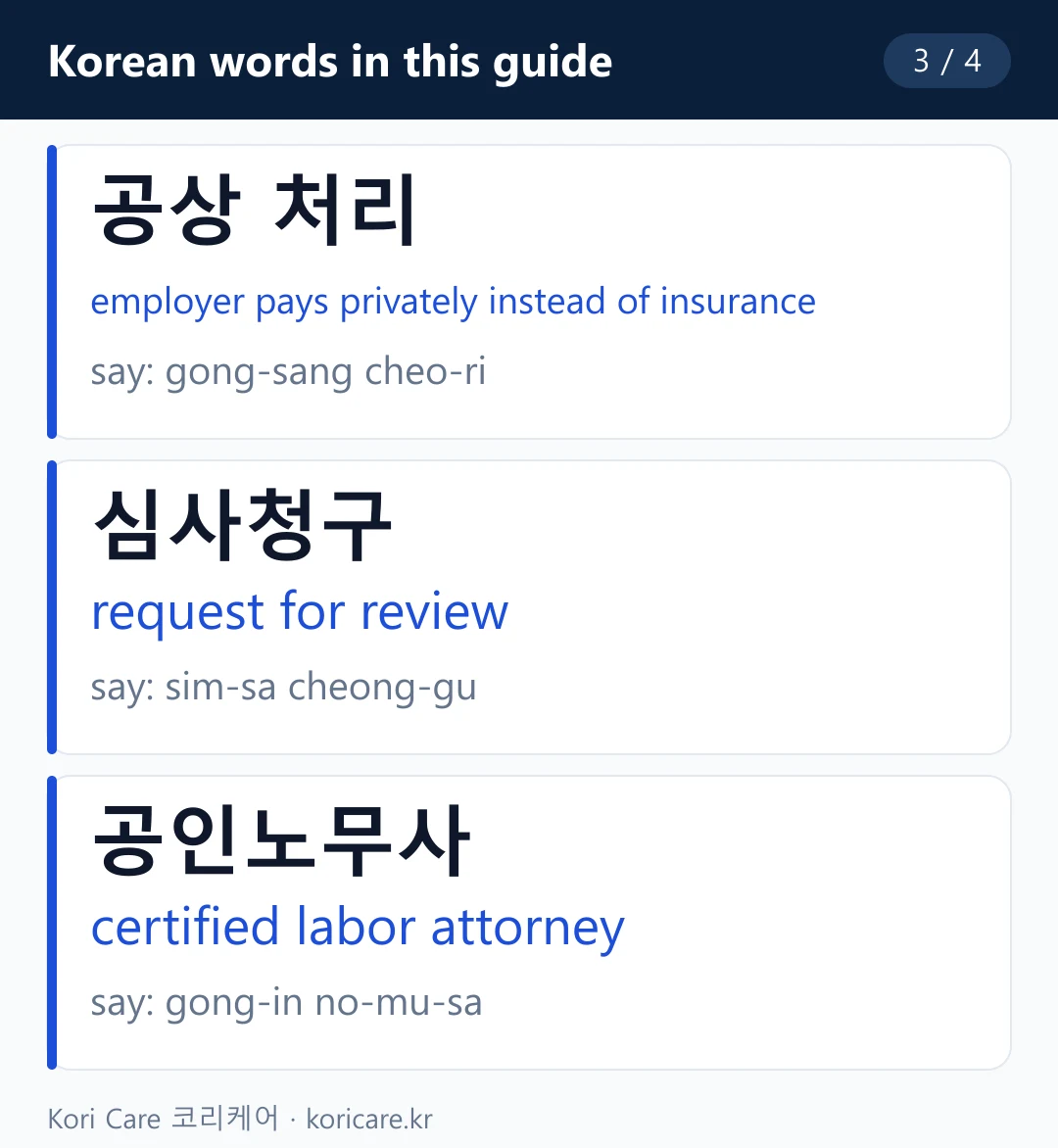
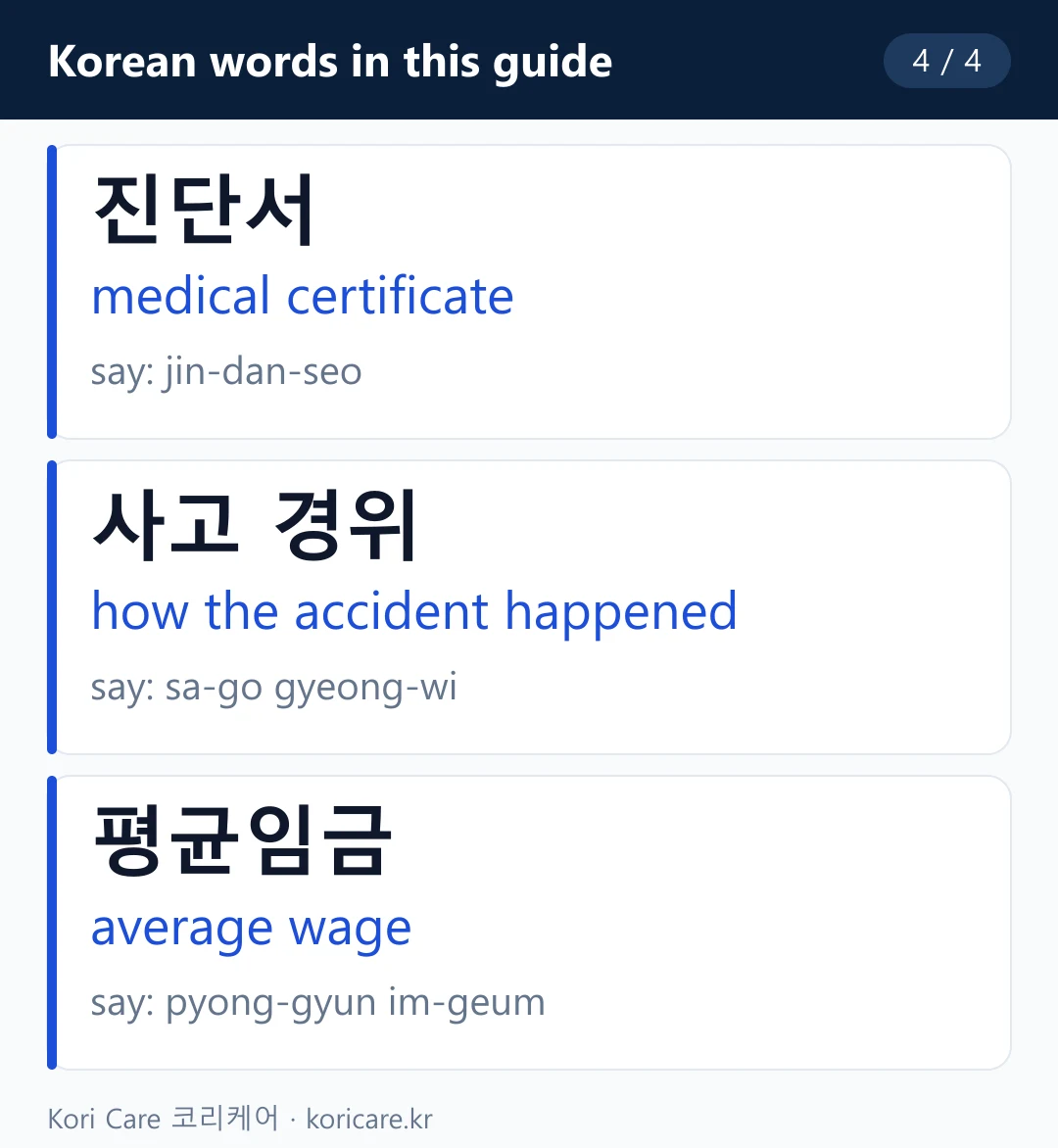
Korean words you will hear
These words appear on your documents and at the counter. Each card shows the Korean word, what it means, and how to say it. You can show a card to the staff.